

From surviving cancer to building platforms for entrepreneurs, Jayshree Naidoo is Carol Ofori’s Woman Crush Wednesday this week. Jayshree Naidoo is an entrepreneur, ecosystem builder, mentor, author and two-time breast cancer survivor whose life and work are rooted in purpose and impact. She serves as the CEO of the Youth Innovation Entrepreneurship Design Institute(YIEDI) and is the founder of WomX Woman in Business. Her career has centred on entrepreneurship development, innovation and advocacy, particularly for women navigating the business landscape Jayshree Naidoo is a TEDx speaker and has been featured across multiple media platforms and publications for her work supporting entrepreneurs and championing women in business. Her contributions to award-winning leadership and entrepreneurship publications reflect a career shaped by thought leadership and practical impact. Jayshree is also the publisher of ‘WomX Her Story Her Success’, a flagship publication highlighting the journeys of 100 women entrepreneurs across South Africa. The publication celebrates resilience, leadership and lived experience while contributing to the national conversation on inclusive economic participation. Alongside her professional work, she is a committed advocate for early breast cancer detection and health awareness. Her lived experience continues to guide her efforts to encourage others to prioritise their health and seek support early. How did her career path take shape? Jayshree spent more than two decades working in corporate South Africa, where she became recognised as a thought leader in innovation and entrepreneurship. Her work focused on designing and implementing programmes and creating spaces that supported enterprise development and innovation. In her final corporate role as head of an incubator for a major bank, she saw how tailored entrepreneurial support programmes could help businesses grow, scale and create lasting economic impact. She also observed where traditional models often fell short by failing to reflect the real lived experiences of entrepreneurs. During this time, her personal life was also undergoing a profound transformation. Her diagnosis as a breast cancer patient changed how she viewed leadership, sustainability and impact. The experience highlighted the importance of early detection, self-advocacy and creating systems that recognise the human being behind the business. This combination of professional insight and personal experience led to the launch of the Youth Innovation Entrepreneurship Design Institute. A few years later, she founded WomX Woman in Business after recognising that women entrepreneurs face unique barriers that are not always addressed through conventional entrepreneurship programmes. What impact has her work had on entrepreneurs? Today, WomX supports a community of more than 700 women who actively share and seek business opportunities daily. The initiative includes a growing digital platform that provides weekly inspiration, including AI tools every FridAI, a free entrepreneurship academy with regularly updated content, free masterclasses and a structured accelerator sponsored by a major bank with more than 200 alumni. Many of these entrepreneurs are featured in WomX Her Story Her Success, further amplifying their journeys and contributions. Jayshree’s work is grounded in a belief that intentional, contextual and human-centred support can transform not only businesses but lives. How did cancer shape her life and leadership? Jayshree’s experience with breast cancer has been central to her journey. She is a two-time survivor and the experience reshaped how she views strength, leadership and resilience. Facing cancer while running a business was one of the most confronting periods of her life. Her first diagnosis led to a double mastectomy and reconstructive surgery. Just two years later, she and her husband contracted COVID-19, and she was hospitalised for six weeks. During that time, she lost her mother to COVID-19 and was unable to attend the funeral. She also lost the use of her legs and had to learn to walk again. There were moments marked by fear, exhaustion and uncertainty. What carried her through was early detection, access to care, a strong support system and learning to ask for help without guilt. These experiences reshaped her definition of strength and reinforced the importance of listening to one’s body and seeking assistance early. Her cancer journey continues to influence how she leads, mentors and advocates. It strengthened her commitment to health awareness and to encouraging conversations that can save lives. What role does family play in her journey? Family has been central to Jayshree’s life and perspective. She has been married for 34 years to her high school sweetheart, whom she describes as her rock. She is a mother to two children, a daughter living in Johannesburg with her husband and two pets, and a son living in Ballito with a love for padel. Her experiences of both profound loss and deep joy have shaped the way she approaches her work. They have brought greater compassion, patience and understanding for the complexities people carry into their professional and personal lives. What recognition has she received? Jayshree’s work has earned recognition across entrepreneurship, health advocacy and innovation platforms. She delivered a TEDx talk titled People are more than the Jobs they Do and has been featured as a thought leader in innovation in a recent Innovation Handbook publication for South Africa. A model she created on the management of innovation was also published in the Innovation Journal of South Africa. The Youth Innovation Entrepreneurship Design Institute was selected as a winner at the Africa Startup Awards for its contribution to entrepreneurship development and ecosystem building. On a personal level, she has received awards recognising her advocacy and resilience as a cancer survivor, promoting early detection and health awareness. She is also an Inspiring Fifty winner, an honour recognising women making an impact in STEM, innovation and technology-related fields in South Africa. What inspires her? Jayshree draws inspiration from resilience in all its forms. She is motivated by entrepreneurs who continue building despite challenges, by women carrying invisible loads while pursuing their ambitions and by individuals who rebuild after failure, illness or loss. Her cancer journey taught her that listening early can change everything. This lesson continues to shape how she leads, mentors, speaks and advocates. She believes that every person’s voice has the power to influence and change lives. What message does she share with others?

Entrepreneur – When life throws you a curve-ball are you ready?
During a recent interview with Ray White on the Money Show on Radio 702, we discussed the challenges that entrepreneurs face and how to adequately prepare for them. In December 2017, I stepped out of the corporate world to join my husband and re-launch our business. Just a month later, during a regular mammogram, I was diagnosed with breast cancer. What followed was a series of decisions, surgical procedures, chemotherapy, treatments and a complete disruption of our lives and our business. Having worked with entrepreneurs for many years and having stepped out of corporate world to be an entrepreneur twice within my career, I wanted to share some practical insights on how to prepare for unexpected challenges and share some of my journey. If you fall ill or have to take care of your loved ones or deal with unexpected personal challenges follow some of these basic principals to ensure sustainability of your business. Always give yourself a financial run way Before embarking on an entrepreneurial journey, ensure you have enough funds to cover your existing expenses for at least 6 to 9 months. This helps in a few ways. Firstly if you are establishing a new venture these funds will allow you to focus on the growth of your business without the stress of trying to sign on clients immediately. Also remember that many clients will not pay up front for your services, and depending on the clients payment processes, your payment can be delayed by up to 90 days from date of invoice. Identify Associates that can Deliver on your behalf If you are a SoloPreneur (the only one in your business) or if you have a unique technical skill that your business is dependent on, identify associates outside your business that can be brought in as and when needed. Negotiate these services and payment structures before you actually need them and create a database of possible associates that you can draw on. Remember that you may need a few associates to cover the spectrum of your skill set, include these contingency plans in all of your proposals to ensure that there is no breech of contract should you need to replace yourself on a project with an associate. Avoid Unnecessary Expenses Its quite tempting when launching a new business to make your mark and create visibility, although this is important be cautious about spending too much of your capital. These expenses could include signing of long term lease contracts with a 3 month up front payment towards rental of office space and could also have lock in and penalty clauses, costing you additional funds should you wish to get out of the contract earlier. Rather opt for a home office space if you are able to or alternatively look into co-working spaces that offer great services for the start up business and they have flexible desk options and month to month contracts if needed. We are situated at the OPEN in Sandton. The facility is professionally managed, open 24 hours, has adequate parking and is ideally located close to public transport and the Gautrain. In addition they have a track record of managing spaces and have locations across the country, which makes your presence in other locations affordable. Other expenses to avoid is permanently employing staff without first getting paying clients for your offering. Your corporate job may have afforded you with the luxuries of a receptionist and a personal assistant, as well as a financial controller and driver, but as an entrepreneur you will need to fulfill as many of these roles as possible until your business can pay for these services without undue pressure on its financials. Ensure you have Adequate Financial Protection Insurance is often thought of as a grudge purchase. However as an entrepreneur you need even more protection as you do not have the added security and benefits as a corporate employee. Ensure you have adequate medical cover that will cover yours and your loved ones medical expenses and look into oncology benefits before you actually need it. In addition investigate and ensure you have policies that will protect your income should you fall ill, or pay you a lump sum as a living benefit or dread disease cover. Discuss these options with your financial adviser, if you do not have a financial adviser speak to family and friends and ask for details of their financial planners that are trusted or search company websites that offer these services. Remember to this this before you actually need it, it is almost impossible to get cover once you have fallen ill. Be Present Being present is absolutely critical to stay relevant. Although you may be facing an unavoidable challenge you will have to get back to your business in the future. Its important for your clients to feel and experience your presence. Although I have not been able to make public appearances and give talks during this year, I have still contributed in the form of articles to publications, I have continued with my social media presence and I have taken a few meetings and interviews when I was able to. But being present also means being available to your loved ones and to yourself. Give yourself the time to heal and deal with your challenge. YOU ARE THE MOST IMPORTANT PERSON YOU KNOW! Do not take life for granted. Your life is precious. Take time for your health. Have your regular check ups and examinations. Breast Cancer is not a death sentence. Have regular mammograms and get your loved ones to do the same. Do not become a statistic. Of all the emotions I have felt this past year, regret is not one of them, don’t let it be one of yours!
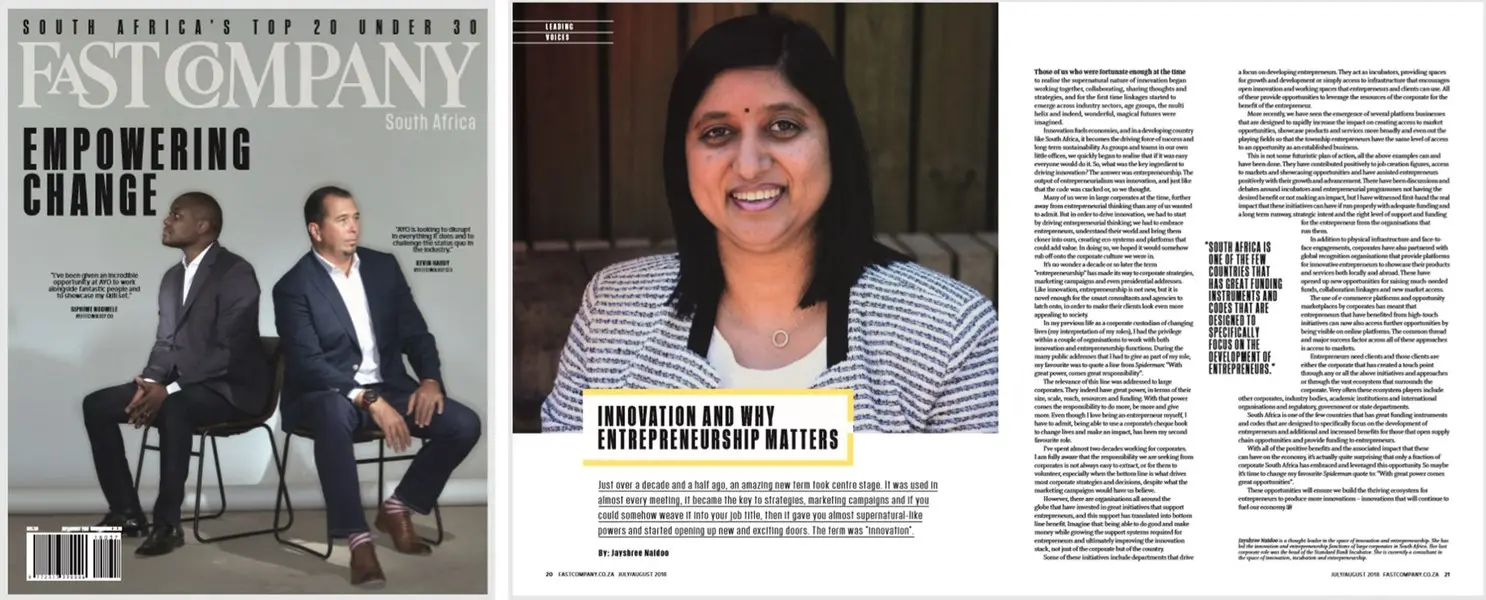
Innovation and Why Entrepreneurship Matters
Just over a decade and a half ago, an amazing new term took centre stage, it was used in almost every meeting, it became the key to strategies, marketing campaigns and if you could some how weave it into your job title then it gave you almost super natural like powers and started opening up new and exciting doors. The term was “Innovation” Those of us who were fortunate enough at the time to realise the super natural nature of innovation began working together, collaborating, sharing thoughts and strategies and for the first-time linkages started to emerge, across industry sectors, age groups, across the multi helix and indeed wonderful, magical futures were imagined. Innovation fuels economies, and in a developing country like South Africa it becomes the driving force of success and long-term sustainability. As groups and teams and in our own little offices we quickly began to realise that if it was easy everyone would do it. So, what was the key ingredient to driving innovation? And the answer was Entrepreneurship. The output of entrepreneurialism was innovation, and just like that the code was cracked or so we thought. Many of us were in large corporates at the time, further away from entrepreneurial thinking than any of us wanted to admit. But in order to drive innovation we had to start by driving entrepreneurial thinking and we had to embrace entrepreneurs, understand their world and bring them closer into ours, creating eco-systems and platforms that could add value and in doing so we hoped it would somehow rub off onto the corporate culture that we were in. Its no wonder a decade or so later and this new term “Entrepreneurship” has made its way to corporate strategies, marketing campaigns and even presidential addresses. But like Innovation, Entrepreneurship is not new but it is novel enough for the smart consultants and agencies to latch onto, in order to make their clients look even more appealing to society. In my previous life as a corporate custodian of changing lives (my interpretation of my roles), I had the privilege within a couple organisations to work with both innovation and entrepreneurship functions. During the many public addresses that I had to give as part of my role, my favourite was to quote a line from Spiderman, “With great power, comes great responsibility”. The relevance of this line was addressed to large corporates. They indeed have great power, in terms of their size, scale, reach, resources, funding and the list goes on. With that power comes the responsibility to do more, be more and give more. Even though I love being an entrepreneur myself, I have to admit, being able to use a corporates cheque book to change lives and make an impact has been my second favourite role. I’ve spent almost two decades working for corporates, I am also fully aware that the responsibility we are seeking from corporates is not always easy to extract, or for them to volunteer especially when the bottom line is what drives most corporate strategies and decisions, despite what the marketing campaigns would have us believe. However, there are organisations all around the globe that have invested in great initiatives that support entrepreneurs and this support has translated into bottom line benefit. Imagine that, being able to do good and make money, while growing the support systems required for entrepreneurs and ultimately improving the innovation stack not just of the corporate but of the country. Some of these initiatives include departments that drive a focus on developing entrepreneurs, incubators that provide spaces for growth and development or simply access to the internet, innovation or industry labs that drive and encourage open innovation and open working spaces that have been made available in unused or dead spaces for the use by entrepreneurs and or clients. All of these provide opportunities to leverage the resources of the corporate for the benefit of the entrepreneur. More recently we have seen the emergence of several platform businesses that are designed to rapidly increase the impact on creating access to market opportunities, showcase products and services more broadly and even out the playing fields so that even the township entrepreneurs have the same level of access to an opportunity as an established business. This is not some futuristic plan of action, all the above examples can and have been done. They have contributed positively to job creation figures, access to markets and showcasing opportunities and have assisted entrepreneurs positively with their growth and advancement. There has been discussions and debates around incubators and entrepreneurial programmes not having the desired benefit or not making an impact, but I have witnessed first hand the real impact that these initiatives can have if run properly with adequate funding and a long term run way, strategic intent and the right level of support and funding for the entrepreneur from the organisations that run them. In addition to physical infrastructure and face to face engagements corporates have also partnered with global recognition organisations that provide platforms for innovative entrepreneurs to showcase their products and services both locally and abroad. These have opened up new opportunities for raising much needed funds, collaboration linkages and new markets access. The use of e-commerce platforms and opportunity market places by corporates has meant that entrepreneurs that have benefited from high touch initiatives can now also access further opportunities by being visible on online platforms. The common thread and major success factor across all of these approaches is access to markets. Entrepreneurs need clients and those clients are either the corporate that has created a touch point through any, or all the above initiatives and approaches or through the vast ecosystem that surrounds the corporate. Very often these ecosystem players include other corporates, industry bodies, academic institutions and international organisations and regulatory or government or state departments. In addition, South Africa is one of the few countries that has great funding instruments and codes that are designed to specifically focus on the development of entrepreneurs and additional and increased benefits for those that open supply chain opportunities
