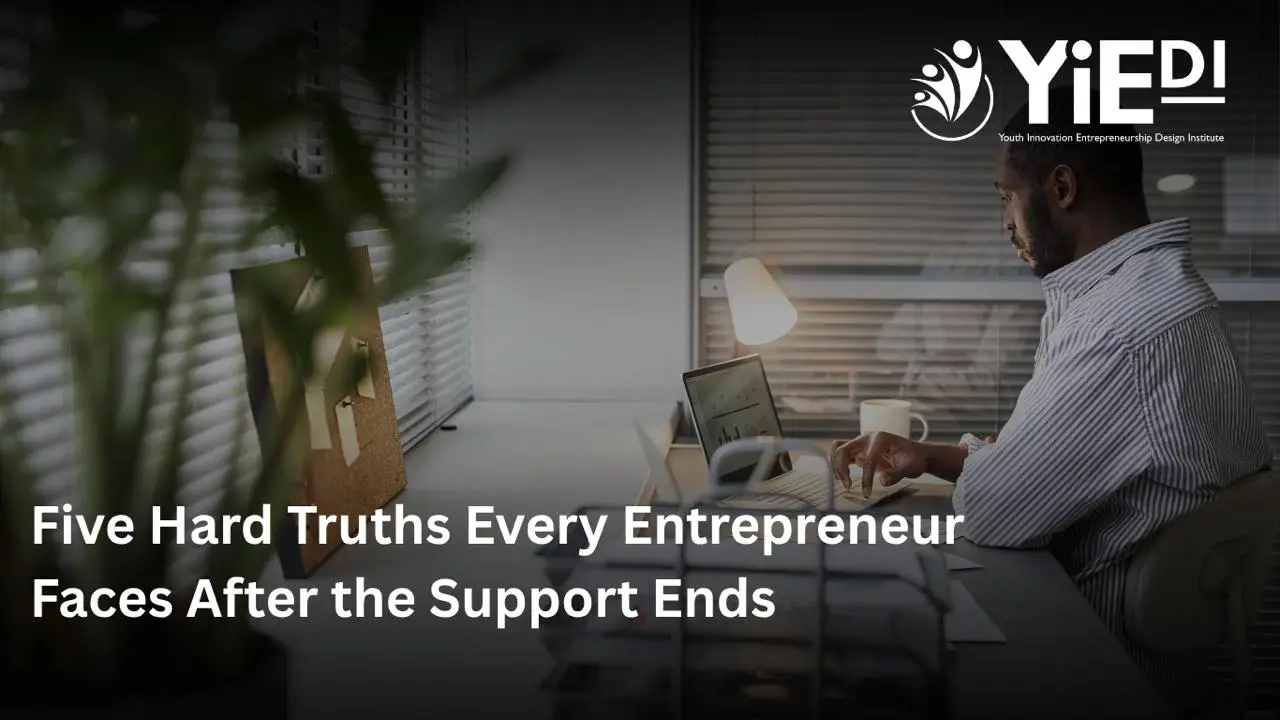
Last week, Gift Lubele had the opportunity to speak as keynote speaker during a graduation ceremony for 27 entrepreneurs, at a programme he has had the privilege of contributing to through YIEDI, the team worked closely with the cohort across mentorship sessions, business strategy, and AI adoption over the past several months for our client. Being part of the graduation, Gift wanted to do more than celebrate. He wanted to prepare them. Because the real test starts the morning after graduation, when the structure falls away and the building truly begins. Here are the five things he shared, lessons drawn from his own journey of building companies, failing publicly, and learning to keep going anyway. 1. Expect the post-programme dip, and plan for it “When the structure disappears, so does the momentum for many entrepreneurs. No more scheduled sessions. No more accountability check-ins. No more mentors automatically in their corner every week”. Many people mistake the end of a programme for the end of growth. That is a dangerous mistake. “The discipline provided by the programme was a framework. Now, the entrepreneurs have to internalise it. They need to build their own rhythm, weekly reviews, and monthly targets. They should find an accountability partner, ideally someone from their cohort, and commit to checking in regularly.” The loneliest trap in entrepreneurship is thinking you have to figure everything out alone. 2. Their biggest competitor is their own excuses Gift spoke about the the longest, most draining conversations of his entrepreneurial life, “Not with difficult investors or sceptical clients, but with myself” The internal voice that says it is too hard, too early, too risky. The version of himself that almost quit. The pitfall he sees most consistently in entrepreneurs is not a lack of skill or access. It is distraction disguised as opportunity. Someone offers a side deal. A new idea feels shinier than the unglamorous work already in front of them. They pivot before their original idea has had a real chance. Focus is a competitive advantage. It must be guarded accordingly. 3. Revenue is validation. Everything else is opinion. “Mentors, including those at YIEDI, can offer frameworks, feedback, and encouragement. But the market is the only stakeholder whose opinion is backed by real data”. One paying customer will tell an entrepreneur more than six months of planning, pitch rehearsals, or feedback surveys ever could. “Entrepreneurs need to stop perfecting and start selling.” If nobody is paying yet, they should not file that away as something to revisit eventually. “They need to ask themselves why, today, not tomorrow. The answer will tell them everything they need to know about where their energy belongs right now.” 4. Use AI, but use it wisely At YIEDI, a significant part of the mentoring work involves helping entrepreneurs understand what AI can and cannot do for their businesses. Gift has seen first-hand what opens up for small businesses when they adopt the right tools. He has also watched entrepreneurs use AI as a crutch rather than a catalyst, Generating content they have not read, automating decisions they have not made, and outsourcing their thinking entirely. “AI should save entrepreneurs time, not replace their judgment. They should use it to write faster, research smarter, and operate leaner. But they still need to know their customers, their numbers, and their value proposition inside out.” The entrepreneurs who win in the next decade are not the ones who fear AI, nor the ones who blindly defer to it. They are the ones who direct it. 5. The network in the room is a real asset, and should be treated like one “The entrepreneurs in this room have spent months alongside people who understand the loneliness, the uncertainty, and the sheer stubbornness it takes to build something from nothing. Most people in their broader lives will never fully grasp what they are attempting. The people in their cohort do.” Gift went on to say, “You should not let these relationships go cold after graduation. You should collaborate, refer each other, and share opportunities before sharing them anywhere else.” South Africa’s economy grows when people grow each other. And in a landscape where access is still unevenly distributed, a strong peer network can open more doors than any single mentor or investor ever will. That is part of what entrepreneurship support programmes are designed to build, and it is theirs to maintain. In closing, programmes like this do something that most business education does not: they meet entrepreneurs where they are. Not in a classroom divorced from real commercial pressure, but inside the actual mess of building a business. The 27 entrepreneurs graduating this week represent exactly the kind of grounded, resilient talent that South Africa’s economy needs. YIEDI is proud of each of them and remains committed to their journey beyond graduation. They are encouraged to stay connected, stay curious, and keep building.
Financial Sustainability for SMEs: Building Businesses That Last
Many small businesses face financial challenges that threaten their long term survival. While entrepreneurs may have strong ideas or market demand, financial management weaknesses can create significant risks. Financial sustainability for SMEs depends on building systems and practices that support long term stability. Through improved financial governance and strategic planning, entrepreneurs can strengthen their ability to manage growth and uncertainty. Mentorship Monday: The Importance of Personal Financial Planning. Why SMEs fail financially Small businesses often fail due to challenges related to financial management. Common issues include poor cash flow planning, underpricing products or services, and inadequate financial controls. Without structured financial management practices, businesses may struggle to maintain profitability. Cashflow management Cash flow management is one of the most important aspects of financial sustainability. Businesses must ensure that incoming revenue is sufficient to cover operational expenses and future investments. Effective cash flow planning helps entrepreneurs anticipate financial challenges and make informed decisions. Pricing and profitability Pricing strategies play a critical role in business sustainability. Entrepreneurs must balance competitive pricing with the need to maintain healthy profit margins. Understanding cost structures and market positioning allows businesses to develop pricing models that support long term profitability. Financial governance Financial governance refers to the systems and processes used to manage financial activities within a business. These may include budgeting, financial reporting, and internal controls. By implementing strong financial governance practices, SMEs can build resilient businesses that are capable of sustaining growth over time. Conclusion Sustainable economic growth requires more than short term interventions. It depends on building strong, inclusive systems that support entrepreneurs and small businesses at every stage of their journey. Whether through youth entrepreneurship, women enterprise development, township economy support, or structured ESD initiatives, the common thread remains clear. Access to skills, mentorship, funding, and markets creates the conditions for long term success. For organisations, investing in enterprise development is not only a compliance or corporate responsibility exercise. It is a strategic opportunity to drive measurable impact, strengthen supply chains, and contribute to a more inclusive and resilient economy. As South Africa continues to navigate its economic challenges, the role of SMEs and entrepreneurship will remain central to unlocking growth, innovation, and opportunity at scale.
Funding Readiness for SMEs: Preparing Businesses for Investment and Growth
Access to funding remains one of the most significant challenges faced by small and medium enterprises. Many promising businesses struggle to secure investment because they lack the financial systems and documentation required by investors. SME funding readiness programmes aim to address this challenge by helping entrepreneurs prepare their businesses for investment opportunities. By strengthening financial management and strategic planning, these programmes improve the ability of SMEs to attract funding. IBM Techscale: Investor Readiness Session. Why funding readiness matters Investors and financial institutions require businesses to demonstrate stability, transparency, and growth potential before providing funding. Entrepreneurs who lack financial records or strategic plans may struggle to meet these requirements. Funding readiness initiatives help SMEs develop the structures required to present their businesses as credible investment opportunities. Financial management fundamentals Strong financial management is essential for any business seeking investment. Entrepreneurs must be able to track revenue, manage expenses, and maintain accurate financial records. Funding readiness programmes often focus on strengthening these capabilities through training and advisory support. Preparing SMEs for investors and procurement In addition to financial management, SMEs must demonstrate clear growth strategies and operational stability. Investors often evaluate factors such as leadership capability, market positioning, and scalability. By developing these elements, SMEs improve their chances of attracting both investment and procurement opportunities.